
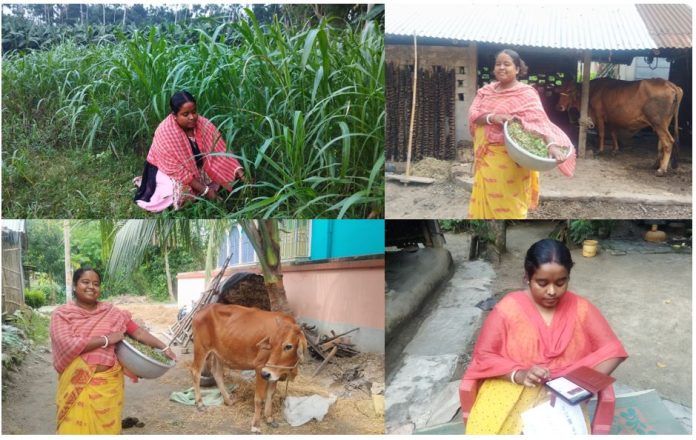
Bithika’s Virtual Village: Leveraging Tech for a Better Tomorrow. In the heart of Nadia district, West Bengal, a quiet revolution is unfolding. It is a story of transformation, empowerment, and resilience—embodied by Bithika Biswas, a woman whose life has been dramatically altered by her journey into cow farming.
Bithika Biswas, a mother of two, has become an unlikely leader in her community, inspiring a shift in how women participate in the economy and perceive their own potential. Her story is one of empowerment, fueled by knowledge, technology, and a determination to create a better life for her family.
A Life of Struggle and Hope Bithika Biswas lives in Taherpur, a small village within the Ranaghat I block. Her household consists of her husband, two sons aged 11 and 3, and her mother-in-law. Before her journey with Reliance Foundation began in 2019, Bithika’s life was marked by financial struggles and limited opportunities. She managed the household chores and helped with vegetable picking and flower planting but had little control over the family’s finances.
The Turning Point
The intervention by Reliance Foundation was the catalyst that changed Bithika’s life. Through various virtual services like programs, including voice massage, WhatsApp groups, helplines, livestock camps, and training sessions on Napier grass cultivation and scientific cow feeding practices, Bithika gained invaluable knowledge. She learned how to grow Napier grass on vacant lands and river banks and how to prepare nutritious feed from vegetable peels and flower waste.
This newfound expertise transformed her cow farming practices. From having just one cow that yielded 5 liters of milk per day, Bithika now owns four cows—two of which are milking cows—thanks to bank linkages and SHG loans facilitated by Reliance Foundation. Her daily milk yield has increased significantly to 6-6.5 liters per day.
Economic Empowerment
The financial impact has been profound. Bithika now earns an additional income of Rs 7000 per month from selling milk at better prices compared to before when middlemen exploited them with low prices. Her total monthly income has surged from Rs 4250 (with minimal profit) to Rs 11100.
Before Intervention: 1 cow x 25 days x 5 liters x Rs 34 = Rs 4250 per month
After Intervention: 2 cows x 25 days x 6 liters x Rs 37 = Rs 11100 per month
Social Change and Empowerment
Bithika’s success is not just about numbers; it’s about the social change it has brought into her life and community. She no longer relies on her husband or family members for small expenses; she can support herself and her children independently. Her pride in being able to provide nutritious food for her family is palpable.
“My younger son is now enrolled in a private nursery school instead of a government school,” she says with a smile. “My elder son still attends a government school, but I hope to change that soon too.” This small but significant decision reflects the broader impact of her newfound financial independence.
Bithika’s aged mother-in-law benefits greatly from this new income as well. She receives better medical treatment and care, something that was previously unaffordable.
Resilience Against Natural Disasters
One of the most compelling aspects of Bithika’s story is her ability to mitigate risks associated with natural disasters. While crops can be damaged or lost due to such events, her cows provide a steady income stream regardless of external conditions.
“Women here have understood that even if crops are damaged due to natural disasters, there is always a steady income from cows if they are raised properly,” Bithika explains. “Many women like me are now coming forward to take care of cows using scientific methods learned from Reliance Foundation.”
A Ripple Effect
Bithika’s journey has inspired many other women in her community to take up cow farming scientifically. They see in her a role model who has not only improved her economic status but also gained social respect within her household. Her village has turned into a virtual community as more than a hundred women now follow her about performing comparable tasks and demonstrating their financial stability.
“We are no longer just homemakers; we are contributors,” says Bithika passionately. “Our value in the household has increased because we are now involved in decision-making processes that were previously dominated by men or elders.”
Conclusion
Bithika Biswas’s story is more than just another case study; it’s a testament to the power of women’s empowerment through sustainable livelihoods. With digital information and support from Reliance Foundation, she has transformed not only her own life but also those around her.
As Bithika looks forward to expanding her cow farm further, she embodies hope and resilience—a beacon for countless other women seeking to break free from traditional roles and forge their own paths towards economic independence and social respect.
In Taherpur village, amidst fields of Napier grass and bustling dairy activities, lies a quiet revolution led by women like Bithika Biswas—women who are redefining what it means to be empowered in rural India.
